From Struggle to Vīra: Applying the Rasa Sūtra to 12th Fail
Perseverance, Failure, and the Aesthetic Experience of Determination
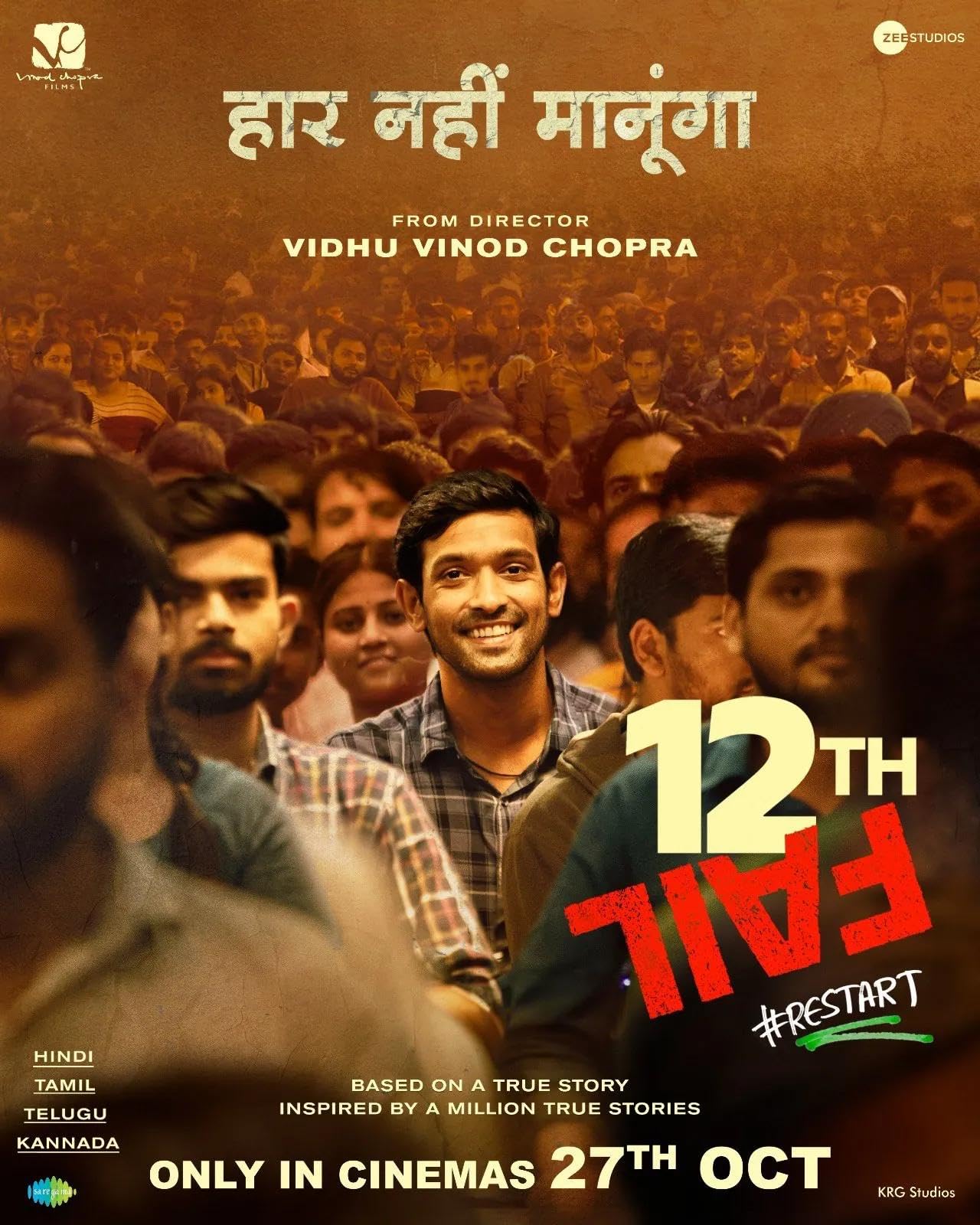
Promotional poster of 12th Fail (2023), directed by Vidhu Vinod Chopra.
Introduction
Vidhu Vinod Chopra’s 12th Fail (2023) is a biographical drama that transforms an apparently ordinary story of academic failure into a powerful narrative of perseverance, hope, integrity, and self-belief. Based on the real-life journey of Manoj Kumar Sharma, the film follows a Hindi-medium student who begins with very limited financial and educational resources but gradually moves towards his dream of entering the civil services. The official description of the film presents Manoj’s movement from Morena to Mukherjee Nagar as a journey through defeats, disappointments, enthusiasm, friendship, fraternity, and love. 1
From the perspective of Indian aesthetic theory, the film is especially significant because its emotional power does not depend simply upon the final achievement of its protagonist. Instead, the audience experiences the repeated cycle of failure, doubt, anxiety, effort, disappointment, and renewed determination. This makes Vīra Rasa, the aesthetic sentiment of heroism and energetic determination, the dominant emotional experience of the film.
The film therefore provides an effective modern example for applying Bharata’s Rasa Sūtra to cinema. Its visual language, acting, sound, setting, relationships, and emotional transitions work together to transform Manoj’s personal struggle into a universal aesthetic experience.
The Rasa Sūtra
Bharata Muni’s famous formulation in the Nāṭyaśāstra states:
“Vibhāvānubhāva-vyabhicāri-saṃyogād rasa-niṣpattiḥ.”
In simple terms, Rasa arises through the combination of Vibhāva (determinants), Anubhāva (consequent expressions), and Vyabhicārībhāva (transitory emotional states). When these elements interact with the appropriate Sthāyibhāva, the spectator experiences Rasānubhava—an aesthetic experience that goes beyond ordinary personal emotion.
In 12th Fail, the dominant emotional foundation is Utsāha, the enduring disposition associated with Vīra Rasa. Manoj’s repeated decision to continue after failure allows this emotional energy to develop progressively until the viewer experiences his perseverance as an aesthetic form of heroism.
Pradhāna Rasa and Aṅga Rasas
The Pradhāna Rasa of 12th Fail is Vīra Rasa. The film, however, does not produce heroism in isolation. Several secondary sentiments enrich the protagonist’s journey and make the final aesthetic experience more complex.
| Rasa | Role in the Film | Emotional Function |
|---|---|---|
| Vīra | Pradhāna Rasa | Perseverance, courage, effort and determination |
| Karuṇa | Aṅga Rasa | Poverty, failure, disappointment and emotional suffering |
| Hāsya | Aṅga Rasa | Humour and lightness within stressful situations |
| Adbhuta | Aṅga Rasa | Wonder at Manoj’s transformation and achievement |
| Śānta | Aṅga Rasa | Inner calm, fulfilment and emotional resolution |
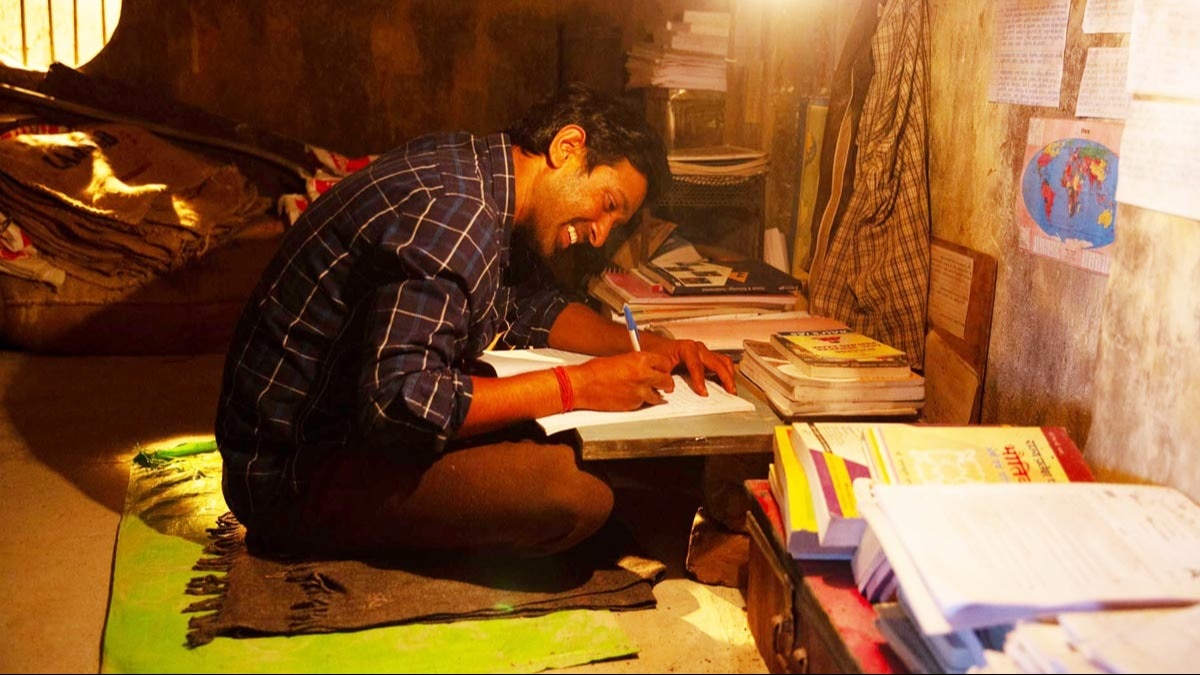
Manoj’s solitary study represents disciplined effort and the growth of Utsāha.
Ālambana Vibhāva: The Primary Emotional Determinants
Ālambana Vibhāva refers to the person, object, or situation that becomes the principal basis for an emotional experience. In 12th Fail, Manoj Kumar Sharma is the central Ālambana Vibhāva because the emotional structure of the film develops around his aspirations, failures, relationships, and repeated attempts to rebuild his life.
His dream of becoming an IPS officer also functions as a crucial emotional determinant. The dream gives direction to his struggle and transforms ordinary hardship into purposeful action. The people around him—including his family, mentors, friends, and Shraddha—further strengthen or challenge his emotional journey.
The official film synopsis emphasizes Manoj’s movement from Morena to Mukherjee Nagar and the series of defeats, disappointments, friendships, and experiences he encounters on the way. 2

Manoj and Shraddha: emotional companionship as part of Manoj’s journey.
Uddīpana Vibhāva: Environment as Emotional Stimulus
Uddīpana Vibhāvas are environmental or contextual elements that intensify an emotional state. In cinema, these can include lighting, location, sound, music, camera movement, costumes, architecture, weather, and spatial atmosphere.
12th Fail uses its physical environment as an important emotional stimulus. The cramped rooms, railway stations, coaching centres, crowded streets of Delhi, examination halls, modest living spaces, and the repetitive atmosphere of Mukherjee Nagar visually communicate the pressure under which the characters live and study.
The film’s realistic visual environment prevents Manoj’s struggle from appearing artificially heroic. Instead, heroism emerges from ordinary spaces. The environment first produces hardship and then intensifies the Utsāha required to overcome it.

The crowded examination environment intensifies anxiety, competition and determination.
The classroom scene is particularly significant. Manoj is visually surrounded by other aspirants, creating an atmosphere of competition and pressure. The crowded space, clock, notebooks, examination materials, and concentrated faces function as Uddīpana Vibhāvas that intensify Śaṅkā, Cintā, and ultimately Utsāha. The published still captures this atmosphere of examination pressure and collective struggle.
Anubhāva: Making Emotion Visible
Anubhāvas are the visible or expressive consequences through which an internal emotional state becomes perceptible. In cinema, acting, facial expression, body language, voice modulation, silence, gestures, movement, and pauses can all function as Anubhāvas.
Vikrant Massey’s portrayal of Manoj makes the internal movement from uncertainty to determination visible through subtle changes in expression and body language. His tired face, hesitant speech, moments of silence, tears, smiles, concentration while studying, and increasingly confident posture communicate emotions without depending entirely on dialogue.
The physical act of continuing to study after failure becomes one of the most important Anubhāvas of Vīra Rasa. The audience does not merely hear that Manoj is determined; determination is repeatedly shown through action.

Emotional expression in the film’s climactic journey from struggle to achievement.
Vyabhicārībhāva: The Transitory Emotional States
Vyabhicārībhāvas are temporary emotional states that arise, change, and support the development of the dominant emotional disposition. In 12th Fail, these fleeting emotions are essential because Vīra Rasa develops gradually through repeated emotional obstacles.
| Vyabhicārībhāva | Manifestation in the Film | Contribution to Vīra |
|---|---|---|
| Śaṅkā | Fear and uncertainty about the future | Makes later courage meaningful |
| Cintā | Financial pressure, exams and uncertainty | Creates emotional tension |
| Śoka | Failure, hardship and disappointment | Deepens the emotional stakes |
| Lajjā | Embarrassment and social pressure | Tests Manoj’s self-confidence |
| Āśā | Hope after moments of failure | Revives Utsāha |
| Harṣa | Moments of friendship and achievement | Provides emotional release |
Rasa-Sūtra Analytical Framework
| Element | Application in 12th Fail |
|---|---|
| Ālambana Vibhāva | Manoj Kumar Sharma, his dream of becoming an IPS officer, family, mentors and relationships |
| Uddīpana Vibhāva | Poverty, crowded coaching centres, Delhi streets, examination halls, railway stations, modest rooms, music and silence |
| Anubhāva | Facial expressions, tears, smiles, hesitation, body language, pauses, voice modulation and persistent study |
| Vyabhicārībhāva | Śaṅkā, Cintā, Śoka, Lajjā, disappointment, exhaustion, hope and emotional agitation |
| Sthāyibhāva | Utsāha — the enduring emotional foundation of Vīra Rasa |
| Pradhāna Rasa | Vīra Rasa — heroism through perseverance and ethical determination |
Emotional Journey: From Śoka to Vīra
One of the most important features of 12th Fail is its gradual emotional progression. The film does not present Manoj as a heroic figure from the beginning. Instead, his heroism develops through repeated emotional testing. His journey moves through failure, doubt, anxiety, hope, effort, and finally determination. This gradual movement is important for understanding how Utsāha becomes the basis of Vīra Rasa.
| Stage | Emotional State | Transformation |
|---|---|---|
| 1 | Śoka | Failure and hardship create emotional vulnerability and suffering. |
| 2 | Śaṅkā | Doubt and uncertainty make Manoj question his ability and future. |
| 3 | Cintā | Financial, academic, and social pressures intensify his anxiety. |
| 4 | Āśā | Friendship, mentorship, and self-belief gradually restore hope. |
| 5 | Utsāha | Hope develops into disciplined effort and purposeful action. |
| 6 | Vīra | Determination becomes the dominant emotional experience. Manoj’s repeated efforts transform hardship into courage and purposeful action. |
| 7 | Śānta | Achievement produces emotional calm, fulfilment, and a sense of inner resolution after the long period of struggle. |
Why Vīra Remains the Dominant Rasa
Although Karuṇa is strongly present in 12th Fail, it does not become the final dominant sentiment. Poverty, failure, disappointment, and emotional suffering create sympathy for Manoj, but the narrative repeatedly moves beyond suffering towards action. Similarly, Hāsya, Adbhuta, and Śānta enrich the emotional texture of the film, but they do not control its overall aesthetic experience.
Vīra Rasa remains dominant because the film repeatedly converts emotional difficulty into purposeful effort. The spectator is not encouraged merely to feel sorry for Manoj. Instead, the audience experiences the strength with which he responds to adversity. His heroism is therefore psychological and ethical rather than merely physical.
The film transforms failure from a final condition into a stimulus for renewed Utsāha.
Central Formula of the Rasa Analysis
Vibhāva + Anubhāva + Vyabhicārībhāva
↓
Utsāha
↓
Vīra Rasa
Central Argument
The central aesthetic achievement of 12th Fail lies in its ability to transform an individual story of struggle into a larger emotional experience. Manoj’s circumstances are specific to his life, but the emotions produced by those circumstances are widely recognisable. Failure, self-doubt, financial pressure, exhaustion, hope, and the desire to improve are not limited to one person or one profession.
Consequently, the spectator does not need to be an UPSC aspirant to connect with Manoj. The film makes his emotional experience accessible by presenting his struggle through ordinary human situations. His journey becomes aesthetically meaningful because the audience can recognise its own fears, hopes, aspirations, and desire for perseverance within his story.
Personal Struggle → Universal Emotion → Aesthetic Experience → Vīra Rasa
The Rasa-Sūtra framework demonstrates that 12th Fail is not simply a story about an aspirant who eventually achieves his goal. Its emotional structure is created through the interaction of Vibhāva, Anubhāva, Vyabhicārībhāva, and Sthāyibhāva. Manoj’s aspirations provide the emotional centre, while his difficult surroundings intensify the struggle. His expressions and actions make his inner emotions visible, and temporary states such as doubt, anxiety, sorrow, embarrassment, exhaustion, and hope continuously nourish his determination.
At the centre of this process is Utsāha, which gradually develops into the dominant experience of Vīra Rasa. The film’s heroism therefore does not depend on extraordinary physical power or dramatic victory. Instead, it emerges from the ordinary but powerful act of continuing despite failure.
Manoj’s defining characteristic is not that he never fails. His defining characteristic is that he refuses to allow failure to become the end of his journey. Every setback becomes another circumstance through which Utsāha can emerge. His repeated efforts transform failure into motivation, uncertainty into determination, and hardship into purposeful action.
Thus, Manoj’s journey demonstrates that true heroism can emerge through perseverance, self-belief, ethical conduct, and the courage to begin again. In this way, 12th Fail presents a modern form of Vīra Rasa in which the simple act of continuing becomes an expression of heroism.
From Visible Emotion to Vīra Rasa
Anubhāva, Vyabhicārībhāva, and the Emotional Expression of Manoj
Anubhāva: Making Inner Emotion Visible
Anubhāva refers to the outward manifestations through which an internal emotional state becomes visible to the spectator. In 12th Fail, Manoj’s emotions are communicated not only through dialogue but also through his facial expressions, gestures, posture, silence, movement, and changes in voice. These visible responses allow the spectator to recognise the emotional struggle taking place within him.
The film uses restrained and realistic acting rather than exaggerated theatrical expression. Manoj’s tired face, moments of hesitation, tears, smiles, silence, and determined body language gradually reveal the movement from vulnerability towards courage. His repeated physical actions—studying, working, travelling, returning after failure, and beginning again—make Utsāha visible as an active force.
| Anubhāva | Emotional Function |
|---|---|
| Facial expressions | Reveal fear, disappointment, hope, determination, and relief. |
| Body language | Shows exhaustion, hesitation, persistence, and gradually increasing confidence. |
| Silence and pauses | Make emotional tension, uncertainty, and reflection perceptible. |
| Tears and smiles | Externalise moments of sorrow, relief, happiness, and emotional release. |
| Persistent action | Makes Utsāha visible through repeated effort rather than through speech alone. |
Vyabhicārībhāva: Temporary Emotional States
Vyabhicārībhāvas are transitory emotional states that arise, intensify, and pass away while nourishing the Sthāyibhāva. In Manoj’s journey, determination does not appear suddenly or independently. It is strengthened through repeated encounters with doubt, anxiety, sorrow, embarrassment, exhaustion, hope, and moments of happiness.
These temporary states create emotional movement within the narrative. They make Manoj’s eventual heroism believable because the audience sees that courage develops through vulnerability rather than in the absence of it. The movement of these states ultimately strengthens the underlying Utsāha.
| Vyabhicārībhāva | Function in Manoj’s Journey |
|---|---|
| Śaṅkā | Doubt about his ability, decisions, and future. |
| Cintā | Anxiety produced by financial, academic, and social pressures. |
| Śoka | Sorrow caused by failure, disappointment, and difficult circumstances. |
| Lajjā | Embarrassment and self-consciousness during moments of failure or difficulty. |
| Āśā | Hope restores Manoj’s willingness to continue after setbacks. |
| Harṣa | Joy emerges through friendship, encouragement, progress, and moments of success. |
| Śrama | Physical and mental exhaustion reveals the cost of continuous effort. |
From Failure to Determination
Manoj’s defining characteristic is not that he never fails. His defining characteristic is that he refuses to allow failure to become the end of his journey. Every setback becomes another circumstance through which Utsāha can emerge. This makes his character particularly suitable for understanding Vīra Rasa, because his heroism lies not in the absence of difficulty but in his ability to continue despite it.
His repeated efforts transform failure into motivation, uncertainty into determination, and hardship into purposeful action. Thus, Manoj’s journey demonstrates that true heroism can emerge through perseverance, self-belief, ethical conduct, and the courage to begin again.
Heroism in 12th Fail is not the absence of failure; it is the courage to continue after failure.
Applying the Rasa Sūtra to 12th Fail
When the complete Rasa-Sūtra framework is applied to 12th Fail, the film’s emotional construction becomes clear. The circumstances surrounding Manoj provide the Vibhāvas; his visible expressions and actions function as Anubhāvas; and temporary states such as doubt, anxiety, sorrow, hope, and exhaustion operate as Vyabhicārībhāvas. These elements interact with the underlying Sthāyibhāva of Utsāha.
| Rasa-Sūtra Element | Application in 12th Fail |
|---|---|
| Vibhāva | Manoj, his aspirations, poverty, relationships, mentors, examination environment, and difficult social circumstances. |
| Anubhāva | Facial expressions, tears, smiles, silence, body language, voice, persistent study, work, and repeated attempts. |
| Vyabhicārībhāva | Śaṅkā, Cintā, Śoka, Lajjā, Āśā, Harṣa, Śrama, disappointment, exhaustion, and emotional agitation. |
| Sthāyibhāva | Utsāha — the enduring energy of courage, perseverance, determination, and purposeful action. |
| Rasa-niṣpatti | The interaction of these elements produces the dominant aesthetic experience of Vīra Rasa. |
Emotional Synthesis
The emotional structure of 12th Fail can therefore be understood as a movement rather than a single emotion. Śoka introduces suffering, Śaṅkā introduces uncertainty, and Cintā intensifies the pressure. Through support and renewed hope, Āśā gradually develops into Utsāha. When this enduring energy is strengthened through the film’s Vibhāvas, Anubhāvas, and Vyabhicārībhāvas, it culminates in Vīra Rasa.
Śoka → Śaṅkā → Cintā → Āśā → Utsāha → Vīra
Through Anubhāva and Vyabhicārībhāva, 12th Fail makes Manoj’s internal struggle visible and emotionally accessible. His expressions, gestures, silence, tears, exhaustion, doubt, hope, and repeated actions demonstrate that determination is not an abstract quality; it is gradually created through lived experience.
The Rasa-Sūtra therefore allows the film to be understood as more than a motivational success story. Its aesthetic power comes from the transformation of ordinary human suffering into Utsāha and finally into Vīra Rasa. The audience experiences not merely the fact that Manoj succeeds, but the emotional strength required to keep moving towards that success.
Character Typology and Prakṛti
Manoj, Uttamaprakṛti, and the Role of Supporting Characters
Character Typology: Prakṛti
In classical Indian dramaturgy, characters can be understood through their Prakṛti, or fundamental disposition and ethical character. Character typology considers qualities such as behaviour, temperament, moral conduct, emotional strength, and the manner in which a character responds to different situations. The categories of Uttama, Madhyama, and Adhama Prakṛti provide a useful framework for examining characterisation.
In 12th Fail, Manoj can be understood most closely through the idea of Uttamaprakṛti. This does not mean that he is presented as a flawless or extraordinary individual. The film openly shows his weaknesses, doubts, mistakes, and failures. His higher characterisation emerges from the way he responds to these difficulties—with honesty, humility, perseverance, respect for others, and a willingness to learn.
Manoj as an Uttamaprakṛti
Manoj’s character is defined less by social status and more by his ethical response to adversity. He begins with limited educational and financial resources, but his aspiration is supported by a strong willingness to learn. His journey demonstrates that personal greatness can emerge from discipline, honesty, humility, and perseverance rather than from privilege or natural superiority.
| Quality | Expression in Manoj |
|---|---|
| Perseverance | He continues working towards his goal even after repeated setbacks. |
| Humility | He remains willing to learn from people around him and does not consider himself superior. |
| Ethical conduct | His progress is connected with honesty and moral responsibility rather than shortcuts. |
| Self-belief | He gradually develops confidence through experience and sustained effort. |
| Respect for others | His relationships with mentors, friends, family, and Shraddha contribute to his emotional growth. |
Therefore, Manoj’s heroism is primarily ethical and psychological. He does not become heroic because he possesses extraordinary physical power. He becomes heroic because he learns how to respond to adversity without surrendering his aspiration. His character demonstrates that the Uttamaprakṛti can be represented through moral strength and perseverance in an ordinary human life.
Gauri Bhaiya: The Mentor as an Emotional Catalyst
Gauri Bhaiya plays an important supporting role in Manoj’s emotional and intellectual development. His presence demonstrates that the journey towards Vīra Rasa is not completely individualistic. Encouragement, guidance, and shared experience can strengthen a person’s inner determination.
Gauri Bhaiya functions as a supportive emotional stimulus. His guidance helps Manoj understand that failure does not necessarily mean the end of an aspiration. Through mentorship, Manoj’s temporary states of doubt and anxiety are gradually redirected towards renewed effort.
Mentorship → Hope → Renewed Utsāha → Vīra Rasa
Shraddha: Emotional Support and Shared Aspiration
Shraddha is also significant in the emotional structure of the film. Her relationship with Manoj provides a space in which ambition is accompanied by emotional understanding and mutual support. Rather than functioning only as a romantic element, her character contributes to the film’s larger idea that perseverance becomes easier when individuals recognise and support one another’s aspirations.
Through their relationship, the film introduces warmth and emotional balance into Manoj’s otherwise difficult journey. This helps the audience experience not only his struggle but also the human relationships that sustain him through that struggle. Their relationship therefore works as a supporting emotional element within the larger movement towards Vīra Rasa.
Supporting Characters and Their Rasa Function
| Character | Function | Contribution to Rasa |
|---|---|---|
| Gauri Bhaiya | Mentor and guide | Encourages hope, learning, and renewed determination. |
| Shraddha | Emotional companion and aspirant | Provides emotional support, warmth, and shared aspiration. |
| Family | Emotional foundation | Strengthens responsibility, attachment, and motivation. |
Prakṛti and the Experience of Vīra Rasa
Manoj’s characterisation as an Uttamaprakṛti strengthens the film’s dominant Vīra Rasa. His determination is not presented as aggressive domination over others. Instead, it develops through self-discipline, ethical conduct, humility, and perseverance. This makes his heroism relatable because the spectator can identify with the human effort behind his achievement.
The supporting characters further nourish this emotional structure. Gauri Bhaiya provides guidance, Shraddha provides emotional companionship, and family relationships provide a sense of responsibility and belonging. Together, these relationships create an emotional environment in which Manoj’s Utsāha can grow.
Character → Ethical Strength → Perseverance → Utsāha → Vīra Rasa
The concept of Prakṛti adds another dimension to the Rasa analysis of 12th Fail. Manoj’s character can be read as an Uttamaprakṛti because his defining qualities are not perfection or superiority, but perseverance, humility, ethical conduct, self-belief, and respect for others. His character makes the film’s Vīra Rasa psychologically convincing.
At the same time, characters such as Gauri Bhaiya and Shraddha contribute to Manoj’s emotional development. Their guidance, companionship, and support demonstrate that courage is also nourished through human relationships. Thus, the film presents heroism as both an individual quality and a relational experience.
Sādhāraṇīkaraṇa and Universal Aesthetic Experience
From Personal Struggle to Rasānubhava and Alaukika Ānanda

Sādhāraṇīkaraṇa: From Individual Story to Universal Emotion
One of the most important concepts for understanding the aesthetic experience of 12th Fail is Sādhāraṇīkaraṇa, or universalization. The film tells the specific story of Manoj Sharma, but the emotions produced by his experiences are not limited to his individual identity or profession. The spectator does not need to be an UPSC aspirant to understand his fear, disappointment, exhaustion, hope, or determination.
Through aesthetic presentation, Manoj’s personal circumstances become emotionally accessible to a wider audience. The spectator may recognise their own experiences of failure, self-doubt, financial pressure, rejection, competition, hope, and the desire for a better future. The particular story therefore becomes a universal emotional experience.
Manoj’s Individual Struggle → Universal Human Emotion
The Process of Sādhāraṇīkaraṇa
| Personal Experience | Universal Emotion | Aesthetic Experience |
|---|---|---|
| Manoj’s examination failures | Fear of failure and disappointment | The spectator recognises the experience of failure |
| Financial difficulties | Anxiety and insecurity | Emotional sympathy and involvement |
| Repeated attempts | Perseverance and hope | Experience of Utsāha and Vīra Rasa |
| Emotional and social support | Trust, companionship, and encouragement | Emotional warmth and deeper involvement |
| Final achievement | Fulfilment and emotional relief | Movement towards Śānta and emotional resolution |
Rasānubhava: The Spectator’s Aesthetic Experience
Rasānubhava refers to the spectator’s experience of Rasa. In 12th Fail, the audience does not merely receive information about Manoj’s life; it emotionally participates in the movement of his journey. The spectator experiences sorrow during moments of failure, anxiety during uncertainty, hope during renewed effort, and finally the uplifting force of determination.
This experience is different from ordinary personal emotion. The audience knows that Manoj’s story belongs to the film, yet the emotions represented through his journey become meaningful beyond the immediate circumstances of the character. The viewer can therefore experience Vīra Rasa without personally undergoing the same struggles as Manoj.
The aesthetic response emerges because the spectator temporarily moves beyond purely practical concerns. Instead of asking whether Manoj’s difficulties are personally happening to them, the viewer experiences the emotional essence of perseverance, courage, hope, and determination. This is the movement from ordinary emotional response towards Rasānubhava.
Alaukika Ānanda: Aesthetic Joy Beyond Ordinary Experience
The concept of Alaukika Ānanda, or non-ordinary aesthetic delight, helps explain why the emotional experience of the film can become pleasurable even when its subject includes poverty, failure, anxiety, and suffering. In ordinary life, failure and financial hardship may produce distress. Within the aesthetic world of the film, however, these experiences are transformed into an artistic and emotionally meaningful experience.
The spectator is temporarily distanced from the practical consequences of Manoj’s problems and is able to experience the emotional essence of his struggle. The suffering therefore becomes part of a larger aesthetic movement towards courage, perseverance, and hope. This transformation is central to the experience of Rasa.
Ordinary Suffering → Aesthetic Transformation → Alaukika Ānanda
Complete Rasa Framework of 12th Fail
Bringing together the previous sections, the complete Rasa framework shows how the different components of the film work together to produce its dominant aesthetic experience. The film does not depend upon one isolated emotional moment. Its Rasa emerges through the cumulative interaction of circumstances, visible responses, temporary emotions, and the underlying Sthāyibhāva.
| Rasa-Sūtra Element | Application in 12th Fail | Aesthetic Function |
|---|---|---|
| Ālambana Vibhāva | Manoj, his aspirations, relationships, mentors, and desire to become an officer | Establishes the emotional centre of the narrative |
| Uddīpana Vibhāva | Poverty, Delhi, railway stations, examination spaces, coaching environments, music, silence, and realistic settings | Intensifies the emotional circumstances |
| Anubhāva | Facial expressions, tears, smiles, silence, gestures, body language, dialogue delivery, and persistent action | Makes internal emotions visible |
| Vyabhicārībhāva | Śaṅkā, Cintā, Śoka, Lajjā, Āśā, Harṣa, Śrama, disappointment, and emotional agitation | Nourishes and develops the underlying emotional state |
| Sthāyibhāva | Utsāha | Provides the enduring emotional foundation |
| Pradhāna Rasa | Vīra | Produces the aesthetic experience of courage and perseverance |
| Sādhāraṇīkaraṇa | Manoj’s specific struggle becomes emotionally universal | Enables shared aesthetic experience |
| Rasānubhava | The spectator experiences the emotional essence of perseverance | Creates aesthetic participation and emotional fulfilment |
The Complete Rasa-Sūtra Movement
Vibhāva
↓
Anubhāva
↓
Vyabhicārībhāva
↓
Utsāha — Sthāyibhāva
↓
Vīra Rasa
Final Argument
The application of the Rasa Sūtra to 12th Fail reveals that the film’s real achievement lies not simply in representing success, but in transforming struggle into an aesthetic experience of courage. Manoj’s individual circumstances become the foundation for emotions that the spectator can recognise in their own life.
The film begins with conditions that generate strong elements of Karuṇa—poverty, failure, uncertainty, and disappointment—but it does not leave the spectator within sorrow. Through repeated effort, support, hope, and perseverance, these emotions gradually contribute to Utsāha. This Utsāha becomes the basis of Vīra Rasa.
The supporting emotions and characters do not compete with the dominant Rasa; instead, they strengthen its development. Karuṇa creates sympathy, Hāsya provides emotional relief, Adbhuta emerges through moments of achievement and possibility, and Śānta provides eventual emotional resolution. Together, these Aṅga Rasas enrich the central experience of Vīra.
Personal Struggle
↓
Universal Emotion
↓
Aesthetic Experience
↓
Vīra Rasa
Conclusion
12th Fail demonstrates how classical Indian aesthetic theory can illuminate a contemporary cinematic narrative. Through the framework of the Rasa Sūtra, Manoj’s journey can be understood as a carefully constructed movement from suffering and uncertainty towards determination, courage, and emotional fulfilment.
The film’s Ālambana and Uddīpana Vibhāvas establish the circumstances of struggle; Anubhāvas make Manoj’s emotions visible; and Vyabhicārībhāvas such as Śaṅkā, Cintā, Śoka, Āśā, and Śrama continuously nourish his emotional development. At the centre of this process is Utsāha, which culminates in the dominant experience of Vīra Rasa.
Through Sādhāraṇīkaraṇa, Manoj’s individual struggle becomes emotionally universal. The spectator does not need to share his profession, background, or exact circumstances. What becomes universal is the human experience of failing, doubting, hoping, working, and beginning again.
Ultimately, 12th Fail transforms the ordinary act of perseverance into an aesthetic expression of heroism. Its deepest significance is not simply that success is possible, but that the courage to continue after failure is itself heroic. Through this transformation of personal struggle into universal emotional experience, the film becomes a compelling modern example of Vīra Rasa.
Personal Struggle → Universal Emotion → Rasānubhava → Vīra Rasa
Works Cited
Scholarly, Encyclopaedic, and Film Sources
Bhattacharya, Arnab. “Tagore and the Indian Tradition of Hāsyarasa: A Study in Tagore’s Shorter Humorous Plays.” Rasa and Indian Aesthetics, JSTOR. https://www.jstor.org/stable/j.ctvt9k5zq.8 .
“Theatre and Its Other: Abhinavagupta on Dance and Dramatic Acting.” JSTOR. https://www.jstor.org/stable/10.1163/j.ctv2gjwsnf .
“Rasa Theory: Interpretations of Bharata Muni and Abhinavagupta.” ResearchGate. https://www.researchgate.net/publication/407242462_Rasa_Theory_Interpretations_of_Bharata_Muni_and_Abhinavagupta .
Anand, Gautam. “Art as Imitation: Indian Aesthetics Approach to Art.” ResearchGate. https://www.researchgate.net/publication/408192800_Art_As_Imitation_-_Indian_Aesthetics_Approach_to_Art .
“A Student’s Handbook of Indian Aesthetics.” ResearchGate. https://www.researchgate.net/publication/357866846_A_STUDENT%27S_HANDBOOK_OF_INDIAN_AESTHETICS_NEERJA_A_CONTENTS .
Sen, Subhrajit. “Rasa Theory with Special Reference to Nāṭyaśāstra.” Academia.edu. https://ugc.academia.edu/SubhrajitSen/Drafts .
Chopra, Vidhu Vinod, director. 12th Fail. Vinod Chopra Films, 2023. https://vinodchoprafilms.com/movies/12th-fail/ .
Zee Studios. “12th Fail | Official Trailer.” YouTube. https://www.youtube.com/watch?v=KjbtuqENvVE .
12th Fail. IMDb, 2023. https://www.imdb.com/title/tt23849204/ .
“12th Fail.” British Board of Film Classification. https://www.bbfc.co.uk/release/12th-fail-q29sbgvjdglvbjpwwc0xmde3mdm3 .
Note: The scholarly sources above support the theoretical discussion of Rasa, Rasa-Sūtra, Rasānubhava, Sādhāraṇīkaraṇa, and Alaukika Ānanda, while the official film sources provide evidence for the analysis of 12th Fail.

No comments:
Post a Comment