NEW AND HYBRID GENRES
Micro-fiction, Graphic Novel and Photo-fiction
Lab Activity–1 | Unit 4: New and Hybrid Genre
Introduction
Literature is not a fixed or unchanging form. It continuously develops according to changes in technology, media, culture, communication and reading habits. In contemporary times, writers have experimented with shorter, more visual and digitally influenced forms of storytelling. These forms are often discussed as new and hybrid genres.
A hybrid genre combines features of different literary or artistic forms. It may bring together text and image, photography and narrative, dialogue and illustration, or literature and digital media. Such forms challenge the traditional boundaries between literary genres and create new ways of telling stories.
Three important examples of new and hybrid genres are micro-fiction, graphic novels and photo-fiction. Each of these forms demonstrates how contemporary literature can communicate meaning through compression, visual representation, sequencing and reader participation.
New and Hybrid Genres explore how contemporary literature transforms storytelling by blending words, images, photography, and digital media:

1. Micro-fiction
Micro-fiction is an extremely short form of fictional narrative. There is no single universally accepted word limit for micro-fiction, but its main characteristic is extreme compression. A micro-fiction story may present an entire emotional situation, conflict, memory or revelation within only a few sentences or words.
Because of its brevity, micro-fiction depends heavily on economy of language, suggestion, implication and ambiguity. The writer does not explain everything directly. Instead, the reader is required to interpret what is left unsaid.
Major Features of Micro-fiction
- Extreme brevity: The narrative is presented in a very limited space.
- Economy of language: Every word has a significant function.
- Focused narrative: It usually concentrates on one moment, situation or experience.
- Limited characters: There is generally little space for extensive character development.
- Implied meaning: Important information may remain unstated.
- Reader participation: The reader completes or interprets the meaning.
- Powerful ending: A revelation, irony or emotional impact is often created at the end.
The strength of micro-fiction lies in its ability to create maximum meaning in minimum space. Its short form also makes it suitable for contemporary digital reading environments where readers frequently encounter literary content through phones and social media.
An Example of Extreme Brevity
A famous example often associated with extremely short fiction is Ernest Hemingway's six-word story:
“For sale: baby shoes, never worn.”
Although the sentence is extremely short, it creates a powerful emotional situation through implication. The reader is not told what happened; instead, the reader imagines the possible story behind the words.
LaPreK: Micro Love Fiction
An important Indian example connected with contemporary micro-fiction is LaPreK (लप्रेक – लघु प्रेम कथा). In the assigned reading “LaPreK – Micro Love Fiction”, Prof. Dr. Dilip Barad discusses this literary trend and connects it with contemporary communication and reading habits.
The form can be understood in relation to the influence of social media such as WhatsApp and Facebook and changing reading habits. Short digital communication has created an environment in which readers increasingly encounter stories in compressed forms.
LaPreK generally focuses on love, relationships, memories, emotions and everyday situations. However, its shortness does not mean that it lacks literary depth. Instead, the limited space encourages the writer to depend upon suggestion and the reader's imagination.
इश्क़ में शहर होना
According to the assigned material, Ravish Kumar's Ishq Mein Shahar Hona is an important example of LaPreK. The work demonstrates how short narratives can capture emotional and relational experiences through concise language.
Ishq Mein Shahar Hona — Ravish Kumar

The importance of इश्क़ में शहर होना in this discussion is that it shows how the boundaries between conventional literary narrative and short contemporary storytelling can become flexible. The form depends upon brevity, emotional suggestion and reader participation.
The work is closely associated with the LaPreK form, which uses short narratives to portray love, urban life, relationships and emotional experiences.
Assigned Reading: LaPreK – Micro Love Fiction – लप्रेक – लघु प्रेम कथा
2. Graphic Novel
A graphic novel is a long-form narrative that combines sequential images with written language. Unlike a conventional novel, where the reader mainly receives the story through words, a graphic novel communicates through the interaction of text and visual elements.
Graphic novels use panels, gutters, speech balloons, captions, facial expressions, gestures, framing, perspective and visual symbols. These elements work together to construct characters, settings, actions and emotions.
A graphic novel is therefore not simply a conventional novel with pictures added to it. The images themselves perform a narrative function. Meaning is produced through the relationship between what is written and what is visually represented.
Major Features of Graphic Novels
- Sequential images: Images are arranged in a meaningful sequence.
- Panels: Individual frames represent different moments of the narrative.
- Gutters: Spaces between panels allow readers to connect events mentally.
- Speech balloons: They represent dialogue and spoken communication.
- Captions: They provide narration, context or additional information.
- Visual symbolism: Images can communicate ideas and emotions without words.
- Layout and framing: Panel arrangement influences narrative pace and emphasis.
Historical Development of Sequential Art
Sequential visual storytelling has a long history. Early newspaper comics played an important role in the development of modern sequential art. Richard Felton Outcault's The Yellow Kid is an important example of early American newspaper comics.
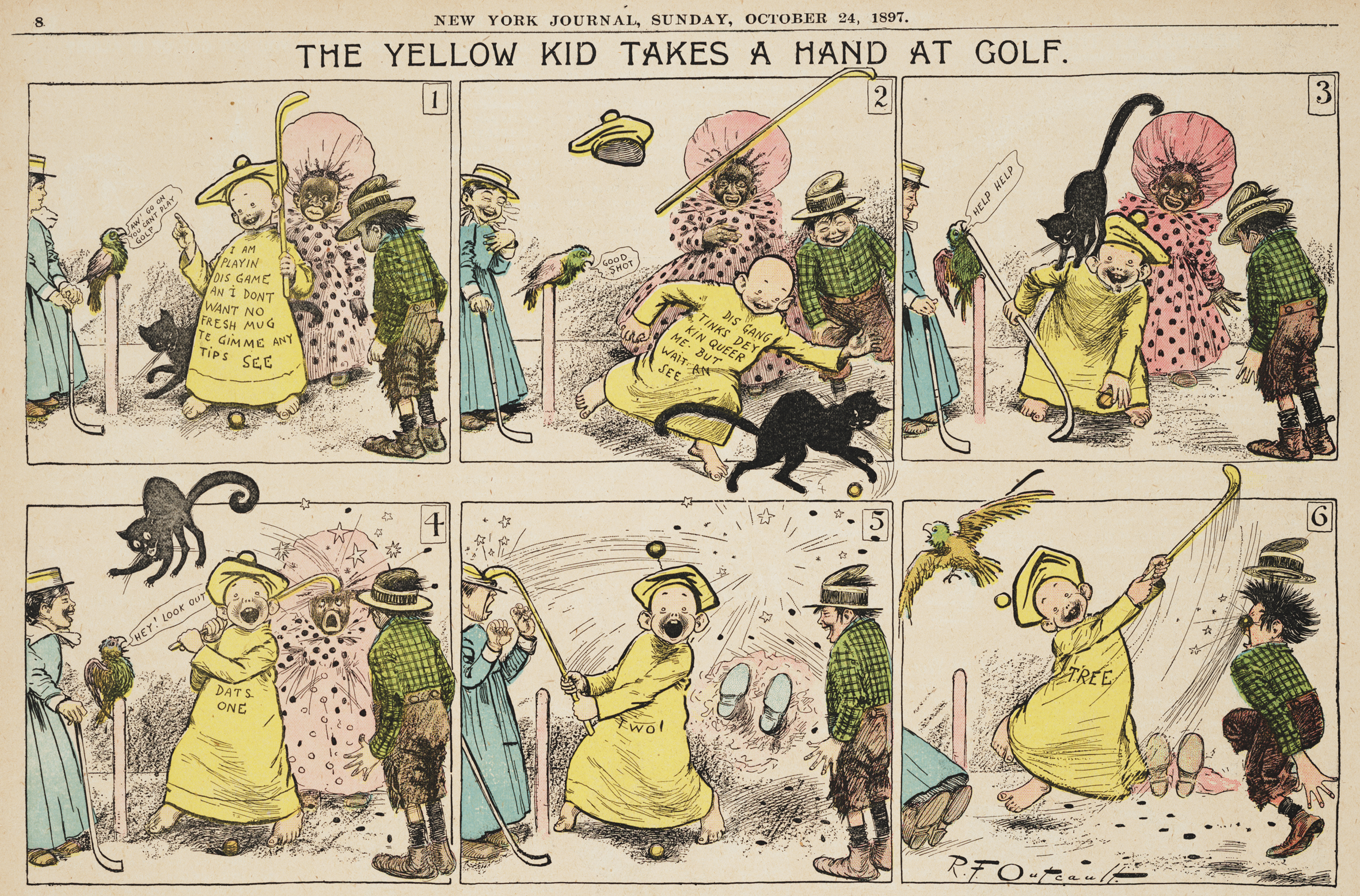
The Yellow Kid Takes a Hand at Golf — New York Journal, 24 October 1897.
This historical comic is particularly useful for understanding the development of sequential visual storytelling. The six panels present a series of connected actions. The reader understands the event not from a single picture, but from the relationship between successive panels.

The Yellow Kid, He Meets Tige and Mary Jane — Richard Felton Outcault, 1907.
The second example contains multiple panels and demonstrates how characters, dialogue, movement and visual action can be developed across a sequence. The reader follows the narrative by moving from one panel to the next.
The Library of Congress describes this 1907 strip as a twelve-panel comic in which the Yellow Kid introduces Buster Brown, Mary Jane and Tige to characters in Hogan's Alley. The sequence finally reveals that the events have been a dream. 3
From Comic Strip to Graphic Novel
Early newspaper comics helped establish important techniques of sequential storytelling. Over time, these techniques developed into more complex forms of visual narrative, eventually contributing to the modern graphic novel.
Modern graphic novels have developed into a serious literary and artistic form. Important examples include Art Spiegelman's Maus, Marjane Satrapi's Persepolis, and Alan Moore and Dave Gibbons's Watchmen.
Why Graphic Novels Are a Hybrid Genre
The graphic novel is a hybrid genre because it combines literary storytelling with visual art. The reader must interpret both words and images at the same time. Dialogue may communicate what a character says, while facial expression, body language, framing and background communicate additional meanings.
Thus, graphic novels demonstrate that contemporary storytelling does not have to depend exclusively on written language. Visual and verbal communication can work together to create a complex narrative experience.
Transition to Photo-fiction
Micro-fiction, graphic novels and photo-fiction demonstrate three different approaches to contemporary storytelling. Micro-fiction creates meaning through the compression of language; graphic novels combine words with sequential visual art; and photo-fiction brings photography and narrative together.
The next section therefore examines photo-fiction / photo-novel and its relationship with digital media, particularly Facebook and other online platforms.
PHOTO-FICTION / PHOTO-NOVEL
3. Photo-fiction / Photo-Novel
Photo-fiction, also called photo-novel or photo-story, is a hybrid narrative form in which a story is communicated through a sequence of photographs supported by captions or short written passages. Unlike a conventional short story, where language carries most of the narrative, photo-fiction gives the photograph an important storytelling function.
The form combines photography, narrative, captions, sequencing and digital media. A photograph can communicate setting, character, emotion, social conditions and an important moment without requiring a long verbal description. When several photographs are arranged in sequence and connected through captions, they can create a complete narrative experience.
Assigned Reading: “Photo-Novel on Facebook”
The assigned reading by Prof. Dr. Dilip Barad, “Photo-Novel on Facebook,” discusses the possibility of narrating stories through a series of photographs shared on social media. The article observes that after the popularity of the graphic novel, photo-novel provides another interesting possibility for storytelling.
According to Barad, photography is a powerful medium because one frame can evoke emotions without the help of many words. A photograph can communicate sadness, happiness, anxiety or social reality through visual representation. Therefore, the arrangement of photographs can become a form of literary narration.
The article presents three examples of stories told through photographs on Facebook: “Avani,” “Mission Impossible? Finding 1 girl in India's 1.25 billion!” and “Social Evil.”
Assigned Reading: Photo-Novel on Facebook — Prof. Dr. Dilip Barad
Example 1: “Avani” — Arjun Kamath
One of the most important examples discussed in the assigned article is “Avani,” a photographic narrative by Arjun Kamath. The story consists of a sequence of 48 photographs and presents the experiences of a woman living within a patriarchal social environment.
The photographs do more than simply illustrate a written story. They themselves become a means of narration. Through expressions, spaces, gestures and situations, the photographs communicate Avani's struggles and experiences. The story therefore demonstrates how photography can become a narrative medium.

Avani — Photo-story by Arjun Kamath
The importance of “Avani” lies in its treatment of an individual story as a reflection of a wider social reality. The problems faced by the central character can be understood as part of larger questions concerning patriarchy, gender, social expectations and women's struggles.
The example also demonstrates that photographs can create emotional involvement. Instead of explaining every emotion through paragraphs, the visual sequence allows the reader to observe the situation and interpret the emotions independently.
Photography as a Narrative Medium
In conventional fiction, the writer usually describes characters, places, actions and emotions through language. In photo-fiction, these functions can be performed partly by the camera and photographic frame. Facial expressions can communicate emotion, locations can establish atmosphere, and the arrangement of photographs can suggest the movement of time.
The photograph therefore becomes more than an illustration. It becomes a narrative unit. When several photographs are placed together, the reader connects them and constructs the story from the relationship between the images.
This makes photo-fiction closely related to other visual narrative forms such as the graphic novel. However, while graphic novels generally use drawn or illustrated images, photo-fiction uses photographic representation.
Example 2: “Mission Impossible? Finding 1 Girl in India's 1.25 Billion!”
The second example in Sir's article presents a story involving a homeless family and an attempt to find a young girl who was seen living under a bridge. The narrative develops through photographs and accompanying captions.
The story demonstrates how photography can record a real social situation and transform it into a human-centred narrative. Instead of presenting the issue only through statistics or abstract discussion, the photographic sequence brings attention to an individual human experience.
The example also shows how social media can become a platform for narrative and social awareness. Photographs shared online can reach a large audience and encourage viewers to respond emotionally to the people and situations represented.
Example 3: “Social Evil”
The third example discussed is titled “Social Evil.” He considers it a good attempt at photo-narration, although he notes that it is less complete than the first examples.
The photographs are effective, but the example highlights an extremely important element of photo-fiction: the caption. Photographs may be powerful, but carefully written captions help establish the relationship between one photograph and the next.
The success of a photo-novel therefore depends not only on the quality of its photographs but also on the precision and effectiveness of its captions. Captions guide interpretation, provide context and help transform separate photographs into a connected narrative.
Important Features of Photo-fiction
- Photographic narrative: Photographs become an essential part of storytelling.
- Sequential arrangement: Images are organised in an order that creates narrative progression.
- Captions: Short written texts connect photographs and provide context.
- Visual storytelling: Characters, emotions, settings and situations are communicated visually.
- Emotional impact: Photographs can produce an immediate emotional response.
- Reader participation: Readers interpret relationships between photographs and captions.
- Digital publication: Social-media platforms provide an accessible space for sharing photo-narratives.
Why Are These Genres Called New and Hybrid?
The three forms discussed in this activity are considered new and hybrid genres because they do not remain within the boundaries of traditional literary categories. They combine different forms of expression and respond to contemporary technology and reading practices.
Micro-fiction combines the narrative qualities of fiction with extreme brevity. Graphic novels combine literary narration with sequential visual art. Photo-fiction combines photography, written language and digital storytelling.
These forms demonstrate that literature can exist beyond the traditional printed page. Contemporary readers encounter stories through social media, smartphones, websites, digital images and multimedia platforms.
Comparison of the Three Genres
| Genre | Main Medium | Major Feature | Reader Experience |
|---|---|---|---|
| Micro-fiction | Words | Extreme brevity and compression | Imagines what is left unsaid |
| Graphic Novel | Words + illustrations | Sequential visual storytelling | Reads and interprets images together |
| Photo-fiction | Photographs + captions | Photographic narrative | Connects photographs and captions |
Role of Digital Media
Digital media has played an important role in the development and popularity of new literary forms. Platforms such as Facebook, WhatsApp, blogs and other social-media spaces allow writers and readers to share short and visual narratives quickly.
The popularity of digital media has also influenced reading habits. Contemporary readers often encounter literary content through mobile phones and social-media feeds. This environment encourages shorter, visually engaging and easily shareable forms.
LaPreK demonstrates the influence of social media on very short literary narratives, while photo-fiction demonstrates how digital platforms can distribute a complete visual narrative through a sequence of photographs.
Reader Participation
New and hybrid genres require an active reader. In traditional narrative, the writer may provide extensive descriptions and explanations. In these newer forms, the reader often has to fill gaps, interpret images, connect fragments and infer meaning.
In micro-fiction, the reader interprets what has been omitted. In graphic novels, the reader connects panels and visual signs. In photo-fiction, the reader connects photographs with captions and constructs a continuous narrative.
Thus, the reader becomes an important participant in the creation of meaning.
Contemporary Significance
The rise of new and hybrid genres shows that literature continues to change according to technology, culture and patterns of communication. These forms do not necessarily replace traditional literature; instead, they expand the possibilities of storytelling.
Micro-fiction demonstrates the power of brevity. Graphic novels demonstrate the narrative power of images and sequential art. Photo-fiction demonstrates how photography and captions can create a meaningful story.
These genres are especially relevant in the digital age because they can be consumed, shared and discussed through online platforms. They also encourage experimentation between literature and other creative media.
Conclusion
The study of micro-fiction, graphic novels and photo-fiction demonstrates the changing nature of contemporary literature. These genres challenge the traditional separation between literary writing and visual media.
Micro-fiction creates maximum meaning through minimum words. Graphic novels combine text and sequential images to construct extended narratives. Photo-fiction uses photographs and captions to tell stories through visual sequences.
The assigned readings by Prof. Dr. Dilip Barad demonstrate how digital culture and changing reading habits have contributed to the emergence of these forms. Ultimately, new and hybrid genres show that literature is not a fixed form but an evolving practice that continuously adapts to new technologies, media and ways of communicating human experiences.
Works Cited / Further Reading
Barad, Dilip. “LaPreK – Micro Love Fiction – लप्रेक – लघु प्रेम कथा.” Dilip Barad: Teacher Blog, 15 Sept. 2017.
https://blog.dilipbarad.com/2017/09/laprek-micro-love-fiction.html
Barad, Dilip. “Photo-Novel on Facebook.” Dilip Barad: Teacher Blog, 21 Dec. 2020.
https://blog.dilipbarad.com/2020/12/photo-novel-on-facebook.html
The Indian Express. “Photographer Arjun Kamath Narrates Gripping Story of Avani Caught in Patriarchy.”
https://indianexpress.com/photos/trending-gallery/photographer-arjun-kamath-narrates-gripping-story-of-avani-caught-in-patriarchy/

No comments:
Post a Comment