Two Ages, One Turning Point
From Feudal Faith to Human Reason
What happens when a society begins to look beyond inherited authority and starts asking questions for itself?
THE QUESTION AT THE HEART OF THIS TRANSITION
Literary history is rarely a simple movement from one period to another. An old world may still be visible while the ideas of a new world are already beginning to emerge within it. The transition from Late Medievalism to Early Humanism was precisely such a moment of transformation. Medieval Europe remained deeply shaped by feudal hierarchy, Church authority, tradition and collective duty, yet a different intellectual curiosity was gradually developing—one that encouraged the study of classical texts, the use of reason, and a closer attention to human life.
This transformation did not mean that religion suddenly disappeared or that medieval values were immediately abandoned. Rather, the centre of intellectual attention slowly began to expand. Alongside questions about God, salvation and social order came questions about human experience, knowledge, character and individual potential.

Chaucer: Standing at the Crossroads
At this intellectual crossroads stands Geoffrey Chaucer. He belonged historically to the fourteenth-century medieval world, yet his poetry demonstrates an unusually sharp interest in the variety and complexity of human beings. In The Canterbury Tales, knights, merchants, clerks, craftsmen, wives, pardoners and other pilgrims are not presented merely as abstract representatives of social categories. They speak, behave, desire, deceive, laugh and contradict themselves.
THE CENTRAL IDEA
The Renaissance did not simply replace the Middle Ages; it grew out of tensions already present within the medieval world.
WORLD I
Late Medievalism
Authority
Church and inherited tradition
Society
Feudal hierarchy and fixed roles
Knowledge
Faith, tradition and established learning
WORLD II
Early Humanism
Inquiry
Reason and critical questioning
Individual
Human personality and potential
Learning
Classical Greek and Roman studies
HUMAN WORLD
THE WORLD HE INHERITED
The Age of Chaucer
A world ordered by faith, hierarchy, duty and tradition
Before Chaucer could observe society, society had already given everyone a place within it.
The England of Geoffrey Chaucer was fundamentally a medieval society. Its institutions, values and everyday relationships were shaped by a powerful sense of order. Land, loyalty, occupation, birth and religious belief influenced a person's position in the social world. The feudal system created networks of obligation between rulers, nobles and those who worked the land, while the Church provided a major framework for understanding morality, education and human existence.
This was not a world without intellectual activity. Medieval scholars debated philosophy, theology and logic, and learning could be highly sophisticated. However, knowledge existed largely within established intellectual and religious frameworks. The important historical development that followed was not simply the disappearance of faith, but the expansion of what counted as valuable knowledge—toward classical languages, literature, history, rhetoric, human experience and the possibilities of reason.
THE MEDIEVAL WORLDVIEW
Four Forces Shaping Medieval Life
Religion shaped moral and cultural life.
Social position was strongly structured.
Loyalty and obligation connected social groups.
Inherited knowledge carried cultural authority.
SOCIAL ORDER
The Three Estates
A traditional model of medieval European society
THOSE WHO PRAY
Clergy · Religious authorities
THOSE WHO FIGHT
Nobility · Knights · Warriors
THOSE WHO WORK
Peasants · Artisans · Merchants · Labourers
HERE THE STORY CHANGES
The significance of Chaucer is that he does not merely reproduce this hierarchy. He places people belonging to different occupations and social positions together and allows them to speak in recognisably different voices. Their social identities remain important, but they are no longer the whole story.
CHAUCER'S LITERARY SPACE
When a Pilgrimage Becomes a Portrait of Society
In The Canterbury Tales, the pilgrimage to Canterbury becomes an ideal narrative setting for this diversity. The pilgrims share a physical journey, but they bring with them different professions, social positions, beliefs, personalities and desires. Chaucer turns this collective journey into a gallery of human character.
The Knight, the Miller, the Clerk, the Wife of Bath, the Pardoner and the other pilgrims cannot be reduced to one identical medieval type. Chaucer observes their speech and behaviour with an eye for individuality. The result is a subtle tension: society gives people their roles, but people give those roles their personalities.
FROM SOCIAL ORDER TO INDIVIDUAL VOICE
Chaucer's realism makes the individual visible within the social structure.
"Whan that Aprill with his shoures soote."
- GEOFFREY CHAUCER · THE CANTERBURY TALES
VISUAL INTERLUDE
The World Chaucer Observed

Through this shift, the medieval social order becomes more than a structure; it becomes a stage on which individual human voices can be heard.
The following visual adaptation brings Chaucer's world of pilgrims, personalities and social identities to life.
SEE CHAUCER'S WORLD
🎬 From Social Types to Living Characters
Watch how Chaucer's world of pilgrims, professions and social classes becomes a vivid world of individual personalities.
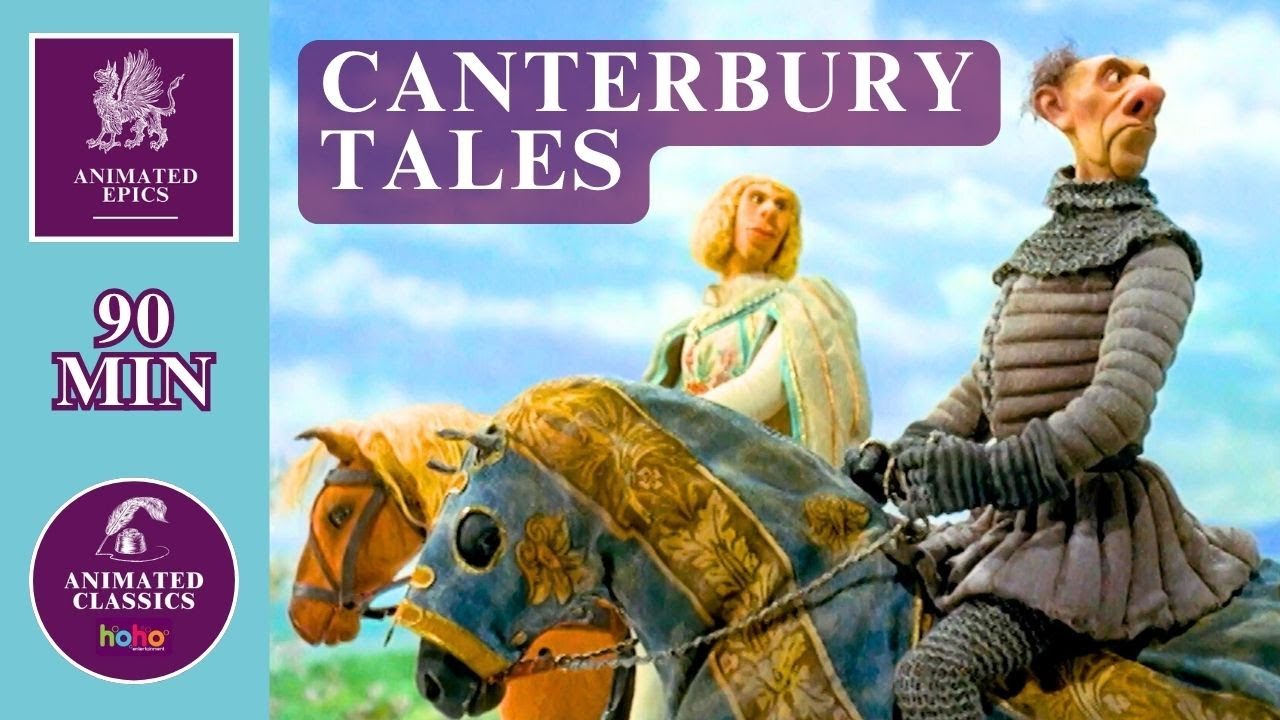
VISUAL ADAPTATION
The Canterbury Tales
A visual journey through Chaucer's pilgrims, their social identities and the individual stories that make them memorable.
WATCH ON YOUTUBE →CHAUCER'S LITERARY TRANSFORMATION
Three Shifts That Changed the Literary Imagination
Chaucer's importance lies in the way he transforms language, observation and character into new possibilities for English literature.
LANGUAGE
The Vernacular
Chaucer's use of Middle English brings literary expression closer to the language of ordinary speakers and a wider English audience.
OBSERVATION
Realism
Instead of presenting idealised figures, Chaucer observes people with their habits, flaws, desires and contradictions.
CHARACTER
Individual Voice
His pilgrims speak in distinctive voices, making personality itself an important source of literary meaning.
CHAUCER'S FORMULA
Social Role
+
Personal Voice
+
Human Contradiction
↓
The Individual Becomes Visible
If medieval literature often placed people within a fixed social order, what happens when literature begins asking us to notice who they are as individuals?
The Revival of Learning
When looking backward became a way of imagining the future
The Revival of Learning marked an important change in the intellectual atmosphere of Europe. Scholars increasingly returned to the languages, literature, philosophy and history of classical Greece and Rome.
This did not mean that medieval learning suddenly disappeared. Instead, older intellectual traditions existed alongside a renewed curiosity about classical texts and new approaches to education, interpretation and inquiry.
At the centre of this transformation was Humanism— an intellectual movement associated with the study of classical languages, literature, history and philosophy, together with a growing interest in education and human capacities.
The Intellectual Journey
Medieval Heritage
Faith, tradition, authority and inherited learning
Classical Recovery
Greek and Roman texts, languages and philosophy
Critical Inquiry
Questioning, comparing and interpreting knowledge
Humanism
Human capacity, education and individual potential
What Changed in the Humanist Mind?
Classical Learning
Renewed engagement with Greek and Roman literature, philosophy and history.
Reason & Inquiry
Knowledge increasingly involved questioning, comparison and interpretation.
Human Potential
Education came to be valued as a means of developing human capacities.
Language & Expression
Language, rhetoric and literary expression became important tools of education.
From Medieval Emphasis to Humanist Inquiry
| Late Medieval Emphasis | → | Emerging Humanist Emphasis |
|---|---|---|
| Inherited authority | → | Critical inquiry |
| Medieval intellectual traditions | → | Recovery of classical learning |
| Collective social order | → | Greater attention to human capacities |
| Tradition as guide | → | Education as development |
Knowledge Opens Outward
A visual representation of the intellectual transition
Inherited Knowledge
↓
Classical Texts + Inquiry
↓
👤
Human Potential
Humanism was not simply “Religion vs Reason”
The transition toward Humanism should not be reduced to a simple rejection of religion or the medieval world. Medieval institutions had preserved texts, educational traditions and intellectual practices. The Revival of Learning expanded the range of classical texts being studied and encouraged new ways of reading, comparing and interpreting them.
Education, Literacy & the “New Learning”
This Open Yale Courses lecture provides historical context for the changing educational and intellectual culture that accompanied the Renaissance and the Revival of Learning.
Chaucer had already begun making the individual visible within medieval society. The Revival of Learning gave this growing attention to human experience a wider intellectual foundation through classical learning, inquiry, education and human potential.
At the Crossroads
Chaucer and Petrarch: Two Voices at the Threshold of Humanism
The transition from Late Medievalism to Early Humanism was not a sudden break. It was a gradual transformation in the ways writers approached knowledge, classical literature, language and human experience.
The following is a creative, imagined dialogue between Geoffrey Chaucer and Francesco Petrarch. It is not presented as a historical meeting. Instead, it brings together two real literary figures whose work helps us understand the movement from medieval culture toward early Renaissance Humanism.
Geoffrey Chaucer
A major English poet of the fourteenth century whose Canterbury Tales presents a richly varied medieval society. His remarkable attention to individual personalities, social tensions and everyday human behaviour makes him an important transitional voice.
Francesco Petrarch
The fourteenth-century Italian poet and scholar whose passionate engagement with classical texts helped shape the revival of learning. His scholarship emphasized recovering, reading and engaging with the intellectual world of antiquity.

From Inherited Tradition to Human Curiosity
Chaucer: “I have written of pilgrims who belong to different estates and carry different responsibilities. A Knight, a Prioress, a Merchant, a Miller— each enters society through a particular role. Yet when they speak, I discover something more than their social position.”
Petrarch: “And that is where literature can become a study of humanity itself. I have turned toward the writers of antiquity because their words allow us to encounter minds from another age. Their wisdom can still speak to the moral and intellectual life of the present.”
Chaucer: “Then the past need not remain buried. It can enter the present through language. I have chosen the vernacular, allowing English voices to tell stories of love, greed, faith, marriage, ambition and deception.”
Petrarch: “And classical learning can deepen that search. The ancient writers teach us not simply what people once believed, but how human beings have struggled with virtue, desire, ambition, failure and the search for a meaningful life.”
Chaucer: “So you would say that returning to the past can actually change the way we understand the present?”
Petrarch: “Precisely. To recover the classics is not simply to admire old books. It is to read them carefully, compare them, learn from them and allow them to challenge the present. Learning becomes an active encounter, not merely the repetition of inherited knowledge.”
Chaucer: “Then perhaps the new age does not begin by forgetting the medieval world. It begins when writers start looking at that world—and at the human beings within it—with a different kind of attention.”
Petrarch: “And when the wisdom of antiquity meets that new attention, the human mind discovers another possibility: not merely to inherit knowledge, but to seek, examine and cultivate it.”
Two Literary Voices → One Intellectual Transition
Chaucer
Vernacular
Social Observation
Individual Voices
Human Character
Medieval Society
Petrarch
Classical Texts
Philological Study
Self-Cultivation
Moral Inquiry
Humanist Learning
+
Revival of Classical Learning
↓
Emerging Humanist Consciousness
Chaucer and Petrarch should not be treated as representatives of two completely separate worlds. Their relationship itself reveals the transition. Chaucer encountered Petrarch's work and adapted Petrarchan material into his own English literary context. In this sense, the movement of ideas across languages becomes part of the movement from medieval literary culture toward Humanism.
Quick Revision
| Medieval Emphasis | Emerging Humanist Emphasis |
|---|---|
| Inherited authority | Critical engagement with texts |
| Social duty and established order | Human capacities and self-cultivation |
| Medieval literary traditions | Recovery of classical learning |
| Social identity | Increasing attention to individual experience |
“The Renaissance did not simply erase the medieval past; it taught Europe to read that past differently—and to look more closely at the human being within it.”
The Historical Road to Humanism
From a century of crisis to a new confidence in books, learning and the human mind.
The movement from Late Medievalism to Early Humanism cannot be reduced to a single date or event. It developed through overlapping changes in European society, education, literary culture, technology and intellectual life. The following timeline traces some of the major moments that help us understand this gradual transformation.
The Road from Medievalism to Humanism
A chronological journey through the crises, cultural movements and technological changes that helped reshape European intellectual life.
The Black Death
The plague caused enormous loss of life and disrupted established social and economic structures.
Geoffrey Chaucer
Chaucer's vernacular poetry and vivid social observation gave increasingly distinctive voices to ordinary and extraordinary people.
Fall of Constantinople
The Ottoman conquest intensified Western European interest in Greek learning, manuscripts and classical scholarship.
Gutenberg's Printing Revolution
Movable-type printing made the reproduction and circulation of texts far more efficient than manuscript copying alone.
Humanist Learning Expands
Grammar, rhetoric, poetry, history and moral philosophy became central to the humanist educational programme.
Humanism Becomes a Cultural Force
Classical scholarship, education, printing and renewed attention to human experience increasingly shaped European intellectual culture.
Important: No single event created the Renaissance. These developments overlapped and gradually transformed European intellectual and cultural life.
From Historical Change to Intellectual Change
Social Crisis
Black Death & social disruption
Cultural Recovery
Greek & Roman learning
Technological Change
Printing expands circulation
Humanist Outlook
Learning, inquiry & human potential
Remember the Turning Points
Social Disruption
Vernacular & Individual Voices
Greek Learning
Wider Circulation
Classical Learning + Human Potential
If the Middle Ages gave Europe its inherited structures,
what changed when people began to rethink those structures?
Two Intellectual Worlds
Late Medievalism and Early Humanism differed not only in what they studied, but also in how they approached knowledge, texts and human life.
The most useful way to understand the transition is through comparison. Medieval culture remained deeply connected with faith, hierarchy and inherited authority, while the emerging Humanist outlook increasingly valued classical learning, eloquence, critical reading and the development of human capacities. These tendencies often overlapped rather than existing as completely separate systems.
What Actually Changed?
From Receiving → Questioning
Learning increasingly involved examining texts, language and inherited ideas with greater attention.
From Social Role → Character
Literary representation increasingly made room for personality, contradiction, desire and individual choice.
From Tradition → Possibility
Education increasingly became a means of cultivating judgment, expression and human capacities.
The Renaissance was not simply the moment when Europe
stopped believing.
It was also a moment when Europe increasingly
began to read, question and rediscover.
And one invention would make this new culture of reading travel faster than ever before.
The Printing Press:
When Knowledge Learned to Travel
The Revival of Learning was not created by one invention, but the printing press transformed the conditions under which knowledge could circulate. Before print, books had to be copied by hand. Manuscripts were expensive, slow to reproduce, and usually remained within restricted circles of monasteries, universities, courts, and wealthy households. Printing changed this relationship between knowledge and access.
With movable-type printing becoming established in Europe in the fifteenth century, texts could be reproduced in much larger numbers. Classical works, religious texts, scholarly writings, dictionaries, grammars, and eventually vernacular literature could reach a wider reading public. The Renaissance mind therefore developed not only through new ideas, but also through new possibilities for encountering and comparing ideas.

One Technology, A Major Cultural Shift
| Manuscript Culture | Print Culture |
|---|---|
| Slow hand-copying | Repeated mechanical reproduction |
| Limited circulation | Much wider circulation |
| Texts difficult to compare | Multiple copies encourage comparison |
| Knowledge remains relatively restricted | Knowledge reaches broader reading communities |
The Machine That Made Us
Watch this documentary to explore Gutenberg's printing press and the revolutionary process through which books could be produced and circulated on a much larger scale. As you watch, think about how a technological invention can become a cultural force.
The printing press did not simply produce more books. It helped create a culture in which texts could be circulated, compared, questioned, translated, and reinterpreted on a much larger scale.
This technological change therefore strengthened the intellectual movement already associated with Humanism. The recovery of classical knowledge became more powerful when that knowledge could travel beyond a small circle of scholars. Reading increasingly became an encounter with multiple voices—and comparison encouraged critical thought. In this sense, the printing press became one of the great material conditions of the Renaissance: it gave ideas a wider audience, and gave readers more opportunities to think for themselves.
When Literature Begins to Look Closely at People
Chaucer stands at a fascinating threshold: he belongs to the medieval world, yet his literary gaze increasingly turns toward the complexity of individual human experience.
The Change Is Not Overnight
The movement from Late Medievalism toward Humanism should not be imagined as a door suddenly closing on one age and opening onto another. Instead, it resembles a gradual change in intellectual emphasis. Medieval society continued to value faith, hierarchy, tradition and inherited authority, while new forms of learning increasingly encouraged attention to language, classical texts, observation, education and human experience.
Tradition
Church
Hierarchy
Society
Behaviour
Experience
Compare
Interpret
Question
Learning
Human Potential
Selfhood
From “Social Type” to “Human Personality”
“Who are you?”
Your estate, profession, religious position and social duty strongly define your place in the medieval order.
“What kind of person are you?”
Chaucer's characters become memorable through their speech, habits, contradictions, ambitions and personal experiences.
Chaucer Makes the Categories Complicated
*This visual is a conceptual literary interpretation, not a quantitative measurement.
So, How Should We Read Chaucer?
If Chaucer asks us to look beyond social labels and notice individual behaviour, then the reader also has to become an observer. This is where a closer introduction to The Canterbury Tales becomes useful.
Everything You Need to Know to Read The Canterbury Tales
This TED-Ed lesson offers a visual introduction to Chaucer's famous collection and helps place its characters, storytelling structure and literary significance into context.
Notice how different characters speak.
Notice how people exceed their social labels.
Notice how Chaucer makes society visible.
the text
the characters
their choices
inherited ideas
The Road from Medievalism to Humanism
Black Death
A devastating demographic crisis reshapes European society, labour and attitudes toward life and death.
Chaucer's Literary World
Vernacular writing, social observation and diverse literary voices expand the possibilities of English literature.
Fall of Constantinople
A major historical turning point associated with the movement of Greek scholars and manuscripts into Western Europe.
Printing Revolution
Movable-type printing accelerates the circulation of texts and ideas, transforming the possibilities of reading and learning.
The question is no longer only
“What place does a person occupy in society?”
It gradually becomes:
“What can we discover when we look closely at the person behind the role?”
And this is where Chaucer's vernacular realism begins to prepare the literary ground for Renaissance individualism.
From Social Identity to Individual Experience
Medieval society largely understood people through their social roles—their estate, occupation, religious duties, and position within the feudal hierarchy. A person was often identified first as a knight, merchant, cleric, peasant, or member of another established social group.
Yet in The Canterbury Tales, Chaucer begins to look beyond these fixed categories. His pilgrims have occupations and social identities, but they also possess desires, contradictions, ambitions, weaknesses, humour, and personal voices. The role remains, but the human being behind the role becomes increasingly visible.
From the Estate to the Person
Chaucer does not simply present representatives of medieval estates. He gives them personalities that complicate their social identities. The Wife of Bath, for instance, is not merely a woman occupying a particular social position. Through her confidence, experience, opinions, and distinctive storytelling voice, she becomes a memorable individual.
Similarly, the Pardoner embodies a religious office, yet his greed, hypocrisy, self-awareness, and manipulation make him much more than a representative of the Church. His character reveals the tension between public identity and private motive.
‘Who am I within that place?’”
The Individual Begins to Speak
This is one of Chaucer’s most important contributions to literary history. He does not suddenly create the fully developed Renaissance individual. Instead, he makes individual human behaviour visible within a medieval social structure.
His characters can follow social expectations while simultaneously challenging them. They can be religious yet hypocritical, respectable yet self-interested, socially defined yet psychologically complex. This attention to contradiction makes Chaucer’s people feel remarkably alive.
Society
The individual exists within an established medieval structure.
Chaucer
The character becomes distinctive through speech, attitude, and storytelling.
Possibility
Personality, desire, choice, and contradiction begin to matter.


When English Became a Language of Human Experience
Chaucer’s literary revolution was not simply a revolution of language. By writing extensively in Middle English, he helped establish the vernacular as a powerful medium for literary expression. English could now carry humour, social observation, moral complexity, personal experience, and the many different voices of society.
The importance of this shift becomes clearer when we connect language with the human mind. A person does not merely occupy a social role; a person thinks, desires, remembers, judges, imagines, questions, and contradicts. Chaucer’s characters increasingly reveal these movements of the mind through their speech and behaviour.
HUMAN
MIND
Chaucer’s characters are not empty social labels. Their language allows us to glimpse the thinking, feeling, desiring, and questioning mind behind the social role.
From Language to the Human Mind
The vernacular makes this inner world more accessible. When characters speak in recognisable human voices, literature becomes capable of representing not only what people are, but also how they think.
The Wife of Bath speaks with confidence and self-awareness. The Pardoner exposes his own contradictions while attempting to manipulate others. The Clerk, the Miller, the Knight, and the other pilgrims similarly contribute different perspectives. Their differences transform the pilgrimage into a meeting of minds, not merely a collection of social types.
ROLE
Society defines the person through estate, occupation, duty, and status.
VOICE
The character speaks, tells stories, expresses opinions, and reveals personality.
INDIVIDUAL
Inner desires, contradictions, choices, and identity become visible.
The Vernacular and the Rise of Realism
Chaucer’s choice of English also strengthens his realism. His literary world contains people who are imperfect, humorous, ambitious, religious, worldly, generous, selfish, sincere, and deceptive. Such complexity makes the characters feel like individuals rather than symbols.
In this sense, language becomes a bridge between society and psychology. The external world of medieval estates meets the internal world of human thought. This intersection is one of the reasons Chaucer stands at such an important point between medieval literary culture and the emerging spirit of Renaissance individualism.
↓
A Literature of Individual Experience
He helped make literature a space where different human minds could speak.

Chaucer and the Seeds of Renaissance Individualism
The movement from Late Medievalism to Early Humanism was not a clean break between two completely separate worlds. It was a gradual change in the ways people understood authority, knowledge, language, and human identity. Chaucer becomes significant precisely because his writing captures this moment of transition.
In The Canterbury Tales, medieval society is still present: its estates, religious institutions, occupations, hierarchies, and moral expectations remain visible. Yet Chaucer does something new with this inherited world. He looks closely at the people living inside it. His pilgrims are not simply representatives of social categories; they possess distinctive voices, desires, prejudices, ambitions, weaknesses, and contradictions.
but the individual behind the role begins to speak.
This is where Chaucer’s vernacular realism becomes historically important. By writing in Middle English, he creates a literary space in which different social voices can be heard. His language brings literature closer to lived experience, while his realism brings attention to the complexity of human behaviour.
The result is a literature increasingly interested not only in what society expects a person to be, but also in how a person thinks, desires, chooses, speaks, and contradicts those expectations. This does not make Chaucer a fully developed Renaissance humanist. Rather, it makes him an important precursor to the intellectual and literary changes that would become more pronounced during the Renaissance.
His achievement, therefore, lies in the opening he creates. The individual does not yet stand completely free from medieval society, but the individual has become visible, audible, and psychologically interesting. That visibility prepares the literary imagination for Renaissance individualism, with its growing interest in human potential, personal identity, intellectual inquiry, and selfhood.
HUMAN
SELF
medieval social types into recognisable human individuals,
helping prepare literature for the Renaissance discovery of the self.
to the questioning mind.
And somewhere between the medieval world he inherited and the Renaissance world that followed, Chaucer gave the individual something literature had rarely given so vividly before: a voice.
References & Media Sources
Academic, literary and visual sources consulted for this blog.
-
British Library.
The Canterbury Tales.
British Library Manuscripts.
https://searcharchives.bl.uk/catalog/040-002107527 -
Open University.
“Knowledge and Ideas.”
Early Modern Europe: An Introduction.
https://www.open.edu/openlearn/history-the-arts/early-modern-europe-introduction/content-section-6.5 -
Open Yale Courses.
“Education and Literacy.”
HIST 251: Early Modern England.
https://oyc.yale.edu/history/hist-251/lecture-17 -
Stanford Encyclopedia of Philosophy.
“Civic Humanism.”
https://plato.stanford.edu/entries/humanism-civic/
Video Sources
-
The Canterbury Tales – Animated Adaptation.
YouTube.
Watch on YouTube -
Open Yale Courses – Education and Literacy.
YouTube / Open Yale Courses.
Watch the Lecture
These sources were consulted for the historical, literary and intellectual background discussed throughout the blog.

No comments:
Post a Comment